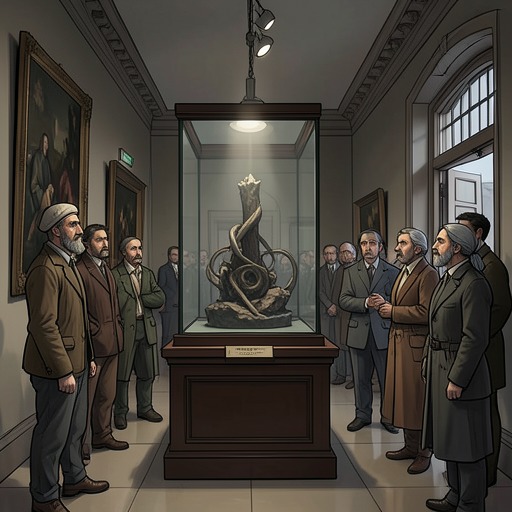
Theodosia Elizabeth Throckmorton
Theodosia and the Serpents of ChaosTheodosia Elizabeth Throckmorton is an eleven-year-old museum-dweller whose ability to sense curses gives her a knowledge adults lack—and a reason to act when they fail to listen. As the daughter of Alistair Throckmorton, Head Curator of the Museum of Legends and Antiquities, she grows up among artifacts, secrets, and dangerous magic. Her story follows the gap between what she perceives and what others are prepared to believe, until her alertness becomes consequential in the struggle over the Heart of Egypt.
Identity and the Museum
Theodosia spends much of her time clattering around the Museum of Legends and Antiquities, the second largest museum in London, which her father oversees. She does not wholly resent this upbringing, but she feels the sting of being overlooked: she wishes Alistair would remember that she is there. The museum’s hidden histories offer both a counterweight to that neglect and a field in which she can make herself useful. She has discovered that she is good at ferreting out secrets—and at recognizing curses, including ancient and dangerous Egyptian magic.
Her intelligence does not automatically win her adult confidence. The narrative identifies her as a clever eleven-year-old, yet she understands that adults tend to side with other adults rather than children. That expectation shapes her position: she is observant and capable, but often has to proceed without the authority that would make others take her seriously. Her distrust of Clive Fagenbush belongs to this wary, investigative outlook. She suspects he is up to something and suspects, in turn, that he has noticed her own secretive activity; the suspicion is mutual, but it does not by itself establish what he is doing.
Sensing Curses and Acting on What She Knows
Theodosia’s curse-sense is immediate and bodily. She can often recognize a spell the first time she looks at an artifact, before she has explained or tested what she has perceived. She describes the sensation as icy-footed beetles crawling down her back. Her parents do not share this ability, and when she meets Lord Wigmere, she is struck by the fact that he knows spells exist at all. His knowledge is real, but his means of identifying bespelled objects differ from hers; he says that his group has other ways of detecting them. The exchange establishes both the distinctiveness of her perception and its limits: she is not the only person who understands magic, but her way of encountering it is unusual.
For Theodosia, sensing a curse is not merely an uncanny talent. It is the beginning of an investigation. The museum’s objects may carry harmful magic, and her habit of noticing what others miss makes her an informal guardian of the people and collections around her. Because adult authority does not guarantee adult awareness, her knowledge repeatedly places responsibility on her while leaving her to negotiate the credibility gap between a child’s warning and an adult’s judgment.
Family, Responsibility, and Attachment
Theodosia’s relationship with her father carries both affection and frustration. She wants Alistair to notice her, yet she is also drawn into his working life and responds when he calls for help. After she returns from a trip to Charing Cross Station, a loud yowl brings her upstairs: Isis has clung to Alistair’s back, and he is turning around with his cane in an attempt to dislodge her. He calls Theodosia to come and get her cat, and she hurries up the stairs. The episode places her within the household’s everyday disorder as well as the museum’s larger mysteries, and shows that her attentiveness is not confined to cursed artifacts.
In another scene, she draws out a carefully wrapped bundle and gives it to her father, eagerly anticipating his pleasure. The gesture offers a quieter counterpoint to her complaints of being overlooked: she, too, notices what might delight him and takes pleasure in producing that response. The scene does not erase the imbalance she feels, but it shows a relationship in which irritation and care coexist.
Her concern for Henry also affects her choices. After she is sent to bed, Alistair and Henrietta Throckmorton stay up late making arrangements and inquiries about Henry’s health. At dawn, while her parents are still asleep, Theodosia slips out with an appointment at the tomb of Thutmose III. She persuades Nabir to take her alone to the Valley of the Kings. He knows how single-minded she can be, and the argument is brief. Her decision shows how readily she turns concern and purpose into independent action, even when the adults responsible for her are occupied elsewhere.
The Tomb and the Heart of Egypt
Theodosia’s perceptiveness becomes decisive in the confrontation over the Heart of Egypt. Injured, with her left arm useless from pain, she watches von Braggenschnott struggle to pull the Heart from the wall. She has found what she hopes is the place that will prevent anyone from taking it again. While he strains against it, she notices magic thickening in the air and gathering into eddies; frankincense rises in the chamber. The Heart glows briefly with an inner warmth, then the wall appears as it had before—except that the Heart now sits where a gaping hole had been.
The reversal leaves von Braggenschnott’s hand stuck to the Heart. He blames Theodosia, but the scene’s consequence is visible before either character can explain it: the object has returned to its place, and the would-be thief is physically held there. Theodosia’s injured body and close attention to the changing magic stand in sharp contrast to von Braggenschnott’s effort to seize the artifact. At this climactic moment, the quality that has defined her throughout the story—recognizing danger in what others might treat as an object to possess—has become a practical force in the struggle over it.